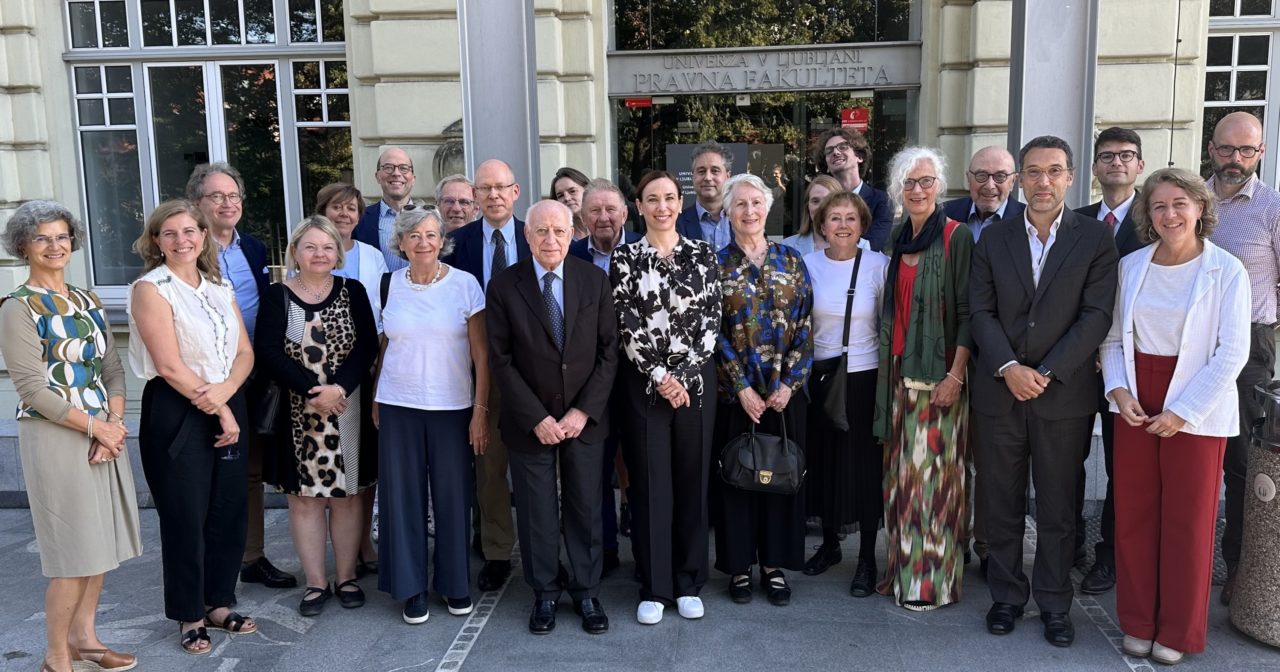
|
| Vingtième réunion Notes * The authors gratefully acknowledge the assistance provided by Maja Groff, Legal Officer at the Permanent Bureau of the Hague Conference on Private International Law. 1. The report served as a basis for Hartley, T.C. Pleading and Proof of Foreign Law: The Major European Systems Compared, ICLQ, 1996, p. 271 et seq. 2. http://www.gedip-egpil.eu/reunionstravail/gedip-reunions-5t.html 3. Cf Art 1 (3) jo Art 18 Rome I and Art 1 (3) jiis Arts 21-22 Rome II. 4. See Preliminary Document No 21 B of March 2007, “Feasibility Study on the Treatment of Foreign Law: Summary Tables on the Status of and Access to Foreign Law in a Sample of Jurisdictions,” prepared by the Permanent Bureau with the assistance of experts, some of which attended the 23-24 February meeting of experts, for the attention of the Council of April 2007 on General Affairs and Policy of the Conference (hereinafter the “Feasibility Study” and / or “summary tables”). This and all other documents drawn up by the Permanent Bureau are available at < www.hcch.net >, under “Work in Progress” then “General Affairs”. 5. See Preliminary Document No 21 C of March 2007, “Feasibility Study on the Treatment of Foreign Law: Legal Norms in Relation to the Treatment of Foreign Law,” Collection drawn up by the Permanent Bureau, for the attention of the Council of April 2007 on General Affairs and Policy of the Conference. 6. See Preliminary Document No 21 A of March 2007, “Feasibility Study on the Treatment of Foreign Law – Report on the Meeting of 23-24 February 2007. 7. See Preliminary Documents No 9A of March 2008, “Feasibility Study on the Treatment of Foreign Law – Summary of the Responses to the Questionnaire”, and No 9B, idem, “Summary Tables and Charts of Certain Responses to the Questionnaire”. 8. See Preliminary Documents No 11 B of March 2009, “Accessing the Content of Foreign Law – Report of the meeting of experts on global co-operation on the provision of online legal information on national laws” and No 11 C, idem, “Compilation of Responses to the Questionnaire of October 2008”. 9. See Preliminary Document no 11A of March 2009 “Accessing the content of foreign law and the need for the development of a global instrument in this area – a possible way ahead”. 10. O.J. L199, 31.7.2007, pp. 48-49. 11. See also the Stockholm Programme: http://www.se2009.eu/polopoly_fs/1.26419!menu/standard/file/Klar_Stockholmsprogram.pdf 12. The Application of Foreign Law by Judicial and Non-Judicial Authorities in Europe: Final General Report and “Basic Principles for a Future EU Regulation on the Application of Foreign Law,” hereinafter “the Valencia Report” or “the Report”. 13. http://ec.europa.eu/justice/tenders/2009/120260/invitation_tender_en.pdf 14. Yates, G.T. Foreign Law Before Domestic Tribunals (1978) 18 Va. J. Int’l L. 725. 15. Hartley, T.C. Pleading and Proof of Foreign Law: The Major European Systems Compared, ICLQ, 1996, p. 271 et seq. 16. Jänterä-Jareborg, M. Foreign Law in National Courts (2003) 304 Recueil des cours 304 (2003), 2004 Martinus Nijhoff Publ. 17. Hausmann, R. Pleading and Proof of Foreign Law – a Comparative Analysis, European Legal Forum, 1-2008, p. I-1 et seq. 18. Fentiman, R. International Commercial Litigation, Oxford, Oxford Univ. Press, 2010. 19. Geeroms, S. Foreign Law in Civil Litigation: A Comparative and Functional Analysis, Oxford, Oxford University Press 2004. 23. Referring to Hausmann, R. op. cit., p. I-2. 24. Referring to Hartley, T.C. op. cit., p. 271. 25. Valencia Report, at p. 11-12 with further references. 26. Valencia Report, at 21-22 with further references. 27. Hague Conference Feasibility Study summary tables, p. 17. 28. Hague Conference Feasibility Study summary tables, p. 36. 29. Hague Conference Feasibility Study summary tables, p. 29. 30. Valencia Report, at p. 23-24 with further references. 31. Swedish Act on International Paternity Issues, Sec. 5. 32. See M. Jänterä-Jareborg, op. cit. at p. 243-244, and Final General Report, at p. 29. 33. Fentiman, op. cit. at p. 209. 34. Hausmann, op. cit., at p. I-5. 35. M. Jänterä-Jareborg, op. cit. at p. 253 – 258. 37. See Introduction and in particular Hartley, T.C. Pleading and Proof of Foreign Law: The Major European Systems Compared, ICLQ, 1996, p. 271 (290-292). 38. Hague Conference Feasibility Study summary tables, p. 17. 39. Hague Conference Feasibility Study summary tables, p. 36. 40. Hague Conference Feasibility Study summary tables, p. 25. 42. Referring to M. Jänterä-Jareborg, op. cit., p. 243. 43. Valencia Report, p. 27 and p. 45. 44. Valencia Report, at p. 30, with further references. 46. Valencia Report, p. 31-32. 47. Valencia Report, p. 12. See above, under Part II, p.6, for a summary of which EU Member States follow which classification. 48. Valencia Report, at p. 21. 49. Hague Conference Feasibility Study summary tables, at p. 25. 50. Hague Conference Feasibility Study summary tables, at p. 15. 51. Hague Conference Feasibility Study summary tables, at p. 32. 52. Valencia Report, at p. 70. 53. Valencia Report, at p. 71. 54. Valencia Report, at p. 63 et seq. 55. Valencia Report, in details at p. 87-88. 56. See the discussion supra, Introduction and Part 2.1.in fine. 57. Hartley, T.C. op. cit., p. 291-292. 58. For instance,
see the South African Constitution, Chapter 2, Bill of Rights, Section
32(1)(a), which enshrines a broad right of access to any information
held by the state.
|
||
| Page d'accueil | Documents
du groupe
Responsable de la page: Bernadette Martin-Bosly Dernière mise à jour le 2-12-2010 |